Andreas Rivera
Sep 29, 2026
Icon Time To Read5 min read

Despite high-speed internet reaching more people than ever, vast connectivity gaps remain across the U.S., with too few options and outdated technology in rural areas. Decent broadband exists in rural areas, but it remains highly localized and siloed in pockets across the country for several reasons. This is evident in the number of small-town areas recording massive year-over-year increases in broadband speeds. 

The rollout of new fiber infrastructure and improvements in wireless 5G have boosted internet performance in rural America to match what you can find in metropolitan suburbs and urban areas. Yet 

We analyzed speed test data from over 500 micropolitan areas (towns with under 50,000 residents) to identify the fastest, slowest, and most improved rural internet speeds in the U.S. How much speed do you really need? Is it

Image by Kayla Fischer for SatelliteInternet.com

What types of internet connections are available in rural areas?

Satellite internet

The most widely available internet connection. Utilizes orbiting satellites to bridge customers to the internet.

5G, fixed-wireless internet

A wireless connection using cellular signals. Widely available anywhere cell service is available.

Cable/DSL

Traditional internet connections that use previously built infrastructure, like coaxial cable or phone lines. Widely available, but speeds are limited.

Fiber

The fastest and most reliable connection to date, which uses specialized cable to transmit data. Requires new infrastructure, which limits availability.

Small towns with the fastest internet speeds

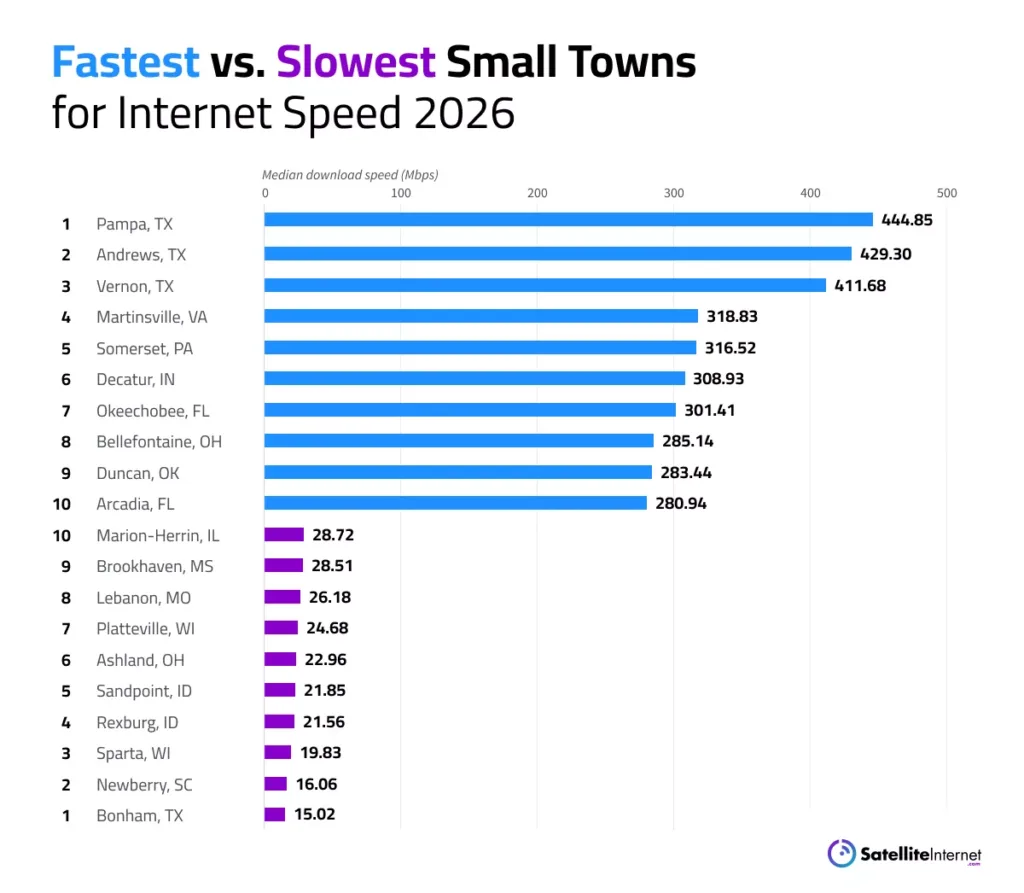
In 2026, an unprecedented number of rural towns recorded median download speeds above 300 Mbps. Texas claims the top three spots for small towns with the fastest speeds. Pampa, Andrews, and Vernon in West Texas each boast median download speeds over 400Mbps. 

The speed boost comes from independent fiber operators building fiber-to-home infrastructure, supported in part by private investment and government grants, to turn these small towns into "gigabit cities" that attract residents and grow industry.

Rank
Town
Average Download Speed (Mbps)
Median Download Speed (Mbps)
1Pampa, TX 396.02 444.85
2 Andrews, TX 415.74 429.30
3 Vernon, TX 385.05 411.68
4 Martinsville, VA 356.63 318.83
5 Somerset, PA 342.82 316.52
6 Decatur, IN 306.74 308.93
7Okeechobee, FL334.30 301.41
8 Bellefontaine, OH 279.75 285.14
9 Duncan, OK 312.54 283.44
10 Arcadia, FL 299.28 280.94

Small towns with the slowest internet speeds

Despite fiber internet making its way to small-town America, much of the rural parts of the country still lag behind in broadband speeds. How much speed does the average household need in 2026? The Federal Communications Commission (FCC) defines the broadband standard as 100 Mbps. Communities at the bottom of the list fall below 30 Mbps, with the slowest as low as 15 Mbps in Bonham, TX. 

Rank
Town
Average Download Speed (Mbps)
Median Download Speed (Mbps)
1Bonham, TX 66.45 15.02
2Newberry, SC 78.30 16.06
3Sparta, WI 100.57 19.83
4Rexburg, ID 68.01 21.56
5Sandpoint, ID 88.19 21.85
6Ashland, OH 126.87 22.96
7Platteville, WI 143.25 24.68
8Lebanon, MO 112.75 26.18
9Brookhaven, MS82.77 28.51
10Marion-Herrin, IL 122.01 28.72

Some towns on the list have obscured median download speeds because of limited speed-test data and other factors. For example, Newberry, SC boasts an average download speed of 78 Mbps, even though the median speed is 16 Mbps. This is likely because Newberry College's 1,500 students benefit from on-campus Wi-Fi, compared with the 37,000 general population sharing residential lines. 

Geography also plays a major role: Sparta, WI (20 Mbps), sits in steep hills and rocky valleys, making fiber buildout harder for many homes and often blocking 5G line of sight. Most homes here rely on legacy DSL or satellite internet.

The Texas connectivity divide: Why the fastest and slowest towns are in the same state

Texas ranks at both the top and bottom of median download speeds. The Lone Star State is so large, with a diverse array of city and town sizes, that the divide reflects its infrastructure disparities and mirrors the country as a whole. However, it's not as simple as saying some towns are luckier than others. 

The towns Pampa, Andrews, and Vernon benefit from regional telecom cooperatives and independent ISPs, typically supported by public grant money and private investment. These towns have shown interest in investing in Fiber-to-the-Home networks to grow local economies and benefit their populations. Bonham, the slowest market on the list, relies on outdated infrastructure, with aging DSL as the primary ISP and wireless broadband spotty in the town, despite its proximity to the outskirts of Dallas. Unfortunately, too few households justify a fiber buildout. State-level averages obscure these local conditions.

Small towns with the most improved internet speeds

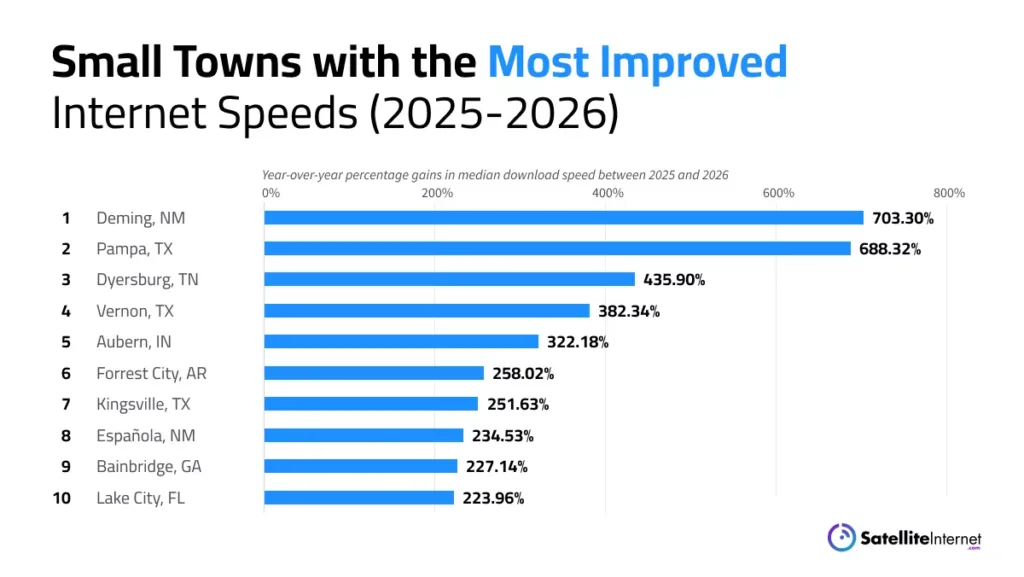
Despite major gaps in internet infrastructure across the country, many communities are making big improvements and transforming internet performance through fiber, wireless broadband, and satellite internet. Deming, NM, leads the charge, with a 703 percent year-over-year improvement in median download speeds between 2025 and 2026. So what's changed for these small towns?

Image by Kayla Fischer for SatelliteInternet.com

What's changing in 2026?

Early 2026 saw several changes across the country that have helped more communities access broadband, whether through fiber or newer alternatives like 5G wireless and low-Earth orbit satellite internet. 

Most importantly, the $42 billion federal Broadband Equity, Access, and Deployment (BEAD) program is currently funding new physical fiber networks in unserved areas. Since its creation in 2021, it has faced several roadblocks to its goal of bridging the digital divide in the country's most underserved areas. Now states and municipalities are finally getting approval for funding to roll out new broadband initiatives specifically for rural communities.

Technology innovations have also played a role. While fiber-to-the-home networks are more expensive and slower to build out, wireless 5G has emerged as a major competitor. Familiar mobile networks like T-Mobile, Verizon, and AT&T have each launched home internet service that can compete with traditional wired internet without major infrastructure construction, bringing broadband speeds to the country's most remote areas.

Going even further, LEO satellite internet technology has emerged, led by SpaceX's Starlink. This differs from legacy satellite internet, which uses geostationary orbit satellites that, while effective, can't deliver internet speeds and latency that match terrestrial internet. LEO satellites represent a huge jump in performance, and unlike most terrestrial providers, Starlink isn't limited in availability and can be used nearly anywhere in the U.S. as long as the sky is clear. 

While Starlink is still a newer internet solution, its worldwide customer base has grown exponentially, with the company claiming 12 million total customers in mid-2026. Speeds and availability of LEO satellite internet are expected to keep climbing into 2027 with the upcoming launch of Amazon Leo internet service and the rollout of Starlink's next-generation satellite constellation, which is expected to deliver gigabit speeds when complete.

What to do if your rural internet is slow

Better internet may be closer in reach than you think. A helpful way to see which providers are available is to use the FCC's National Broadband Map. It's frequently updated to show which providers are available at your address, so you may have more options than when you first shopped around.

If you're wondering whether fiber is being planned for your area in the near future, contact your local utility companies. Electric utility providers have played a big role in building out fiber because their existing infrastructure and rights-of-way make it easier to reach rural households. Your local utility may have partnered with independent providers, or may even be leading the effort to expand fiber availability. It can't hurt to find out if you could be one of the first in town.

Despite the superiority of a fiber connection, many places still can't make it work because it's too impractical or lacks the investment to become reality. Luckily, 5G wireless and satellite are filling in the gap. Legacy satellite and fixed-wireless providers have made rural internet possible for years, but technology has taken an extraordinary leap forward, and broadband speeds are now possible. Switching to 5G wireless supported by national networks can boost speeds, while Starlink satellite internet continues to improve performance and network capacity.


Methodology

To determine our list of the 10 small towns with the fastest and slowest speeds, we pulled ZIP codes for 502 micropolitan statistical areas with populations of 100,000 people or less, using Census Bureau data. We then examined HighSpeedInternet.com speed test results from those ZIP codes between August 2025 and July 2026, and compared them to the previous 12-month period to find the most and least improved areas.

We filtered out cellular connections and multiple tests from the same IP address. We calculated median download speeds for each area with five or more speed tests to identify the fastest and slowest speeds, and we used year-over-year percent change to identify the most and least improved areas.

Andreas Rivera
Written by
Andreas Rivera is a lifelong writer with a decade-spanning career in journalism and marketing. He comes to SatelliteInternet.com with several years of experience writing about business and technology. His passion for researching the latest advancements in tech, especially the now essential need for reliable internet access, fuels his goal of educating others about how these innovations affect and improve our everyday lives. When not researching and writing about SatelliteInternet.com, you’ll likely find him buried in a good book or enjoying the great outdoors with a fishing rod.