Satellite Internet Statistics 2026: The Space Race to Connect Rural America


Andreas Rivera
Apr 30, 2026
Icon Time To Read5 min read

About 93.3% of Americans have some form of internet subscription. It gives us access to remote work, telemedicine, educational opportunities, and limitless entertainment.

However, if you live at the end of a long dirt road, you already know the struggle: getting a reliable, high-speed connection in rural America is still a massive challenge. While satellite internet has historically been slower and more expensive than traditional fiber or cable, explosive advances in low Earth orbit (LEO) technology have radically changed the landscape. Today, satellite providers can connect you virtually anywhere in the country.

Read on to learn more about the state of satellite internet in 2026, including who is using it, how much it actually costs, and how the technology is evolving.
Coverage & Access: The Digital Divide

The Federal Communications Commission (FCC) currently defines broadband internet as a connection providing at least 100 Mbps download and 20 Mbps upload speeds.

While roughly 95% of U.S. homes and businesses have access to terrestrial broadband that meets this standard, about 5% of locations—roughly 6 million addresses—remain completely unserved by ground-based providers. For these Americans, satellite is often the only high-speed option available.

Image by Kayla Fischer for SatelliteInternet.com

Many of the gaps in internet access occur in rural areas, where 66 million Americans (20% of the U.S. population) live. Here is the reality of broadband access today:

  • About 28% of rural Americans still lack fixed broadband access.
  • Around 23% of Americans living on Tribal lands lack fixed broadband.
  • Approximately 6.7% of U.S. households have no internet subscription.
  • The Affordable Connectivity Program (ACP) ended in 2024, and its discontinuation directly correlated with the widening of the urban/rural broadband gap in 32 states.

While the FCC's official estimate claims 19.6 million Americans lack 100/20 Mbps broadband, independent audits suggest this is a massive 33% undercount due to ISP over-reporting. The true figure of unserved Americans is likely closer to 26 million.

Fortunately, satellite availability is nearly universal. Viasat and Hughesnet boast 100% U.S. coverage, while Starlink covers 99.7% of U.S. households.

Writer's Note on "Coverage"

Just because an FCC map says a signal can technically reach an address does not necessarily mean the service is easily orderable, affordable, or reliable in that exact spot. Furthermore, satellite signals can degrade with rough terrain, dense tree cover, and severe weather—factors highly relevant to the rural communities that rely on them most.

Industry Scale & Subscriber Growth

The satellite internet industry is growing at an unprecedented rate. The global market is valued at $11.9-$14.6 billion in 2025 and is projected to reach $33.4 billion by 2030. North America currently holds the largest regional share at roughly 32% to 34% of the global market.

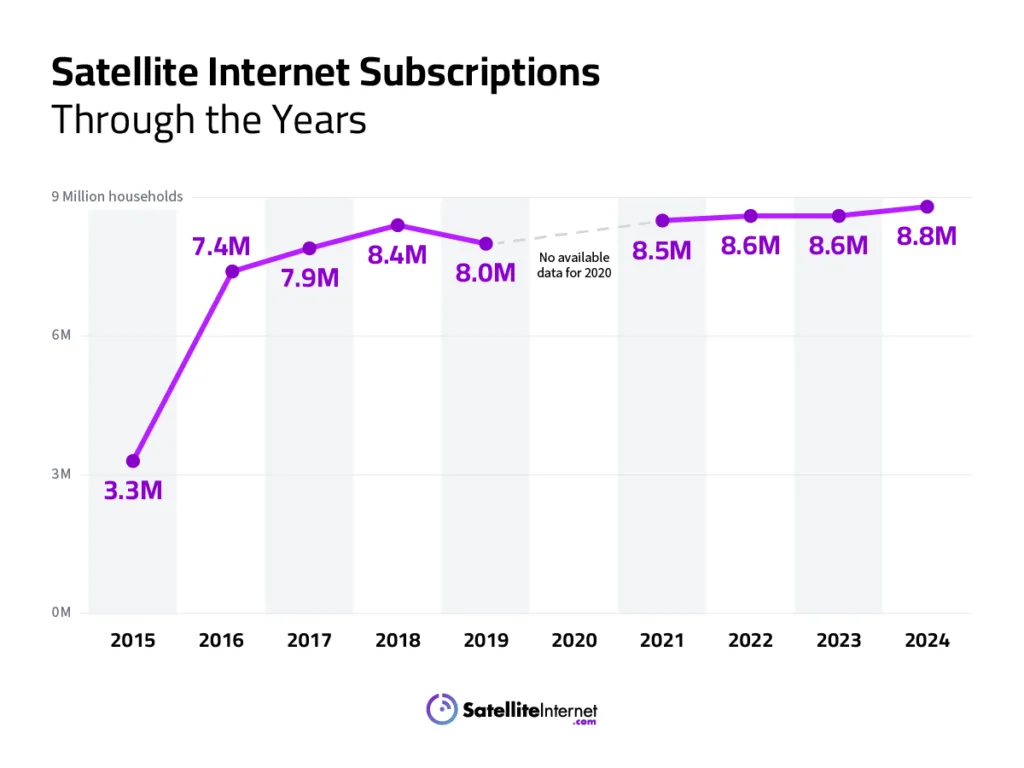
The number of active U.S. satellite internet subscribers has hit 8.8 million, representing an incredible 169% increase over the last decade (up from 3.3 million in 2015). Globally, there are 11.8 million broadband satellite subscribers.

Where are these users going? Let's look at the provider breakdown:

  • Starlink: SpaceX's LEO provider dominates the industry, accounting for 76% of all global satellite subscriptions. As of early 2026, Starlink surpassed 10 million global subscribers, with an estimated 2.6 million in the U.S. alone.
  • Hughesnet: The long-time provider sits at approximately 783,000 subscribers, down from a peak of 1.6 million in 2020. Parent company EchoStar's recent SEC filings suggest the company may begin referring customers to Starlink, signaling a potential wind-down of its consumer business.
  • Viasat: Viasat is down to roughly 189,000 U.S. residential subscribers as the company pivots its focus toward aviation and maritime internet services.

Cost & Affordability

While satellite internet is widely available, it remains one of the most expensive options for getting online due to the massive costs of launching space infrastructure.

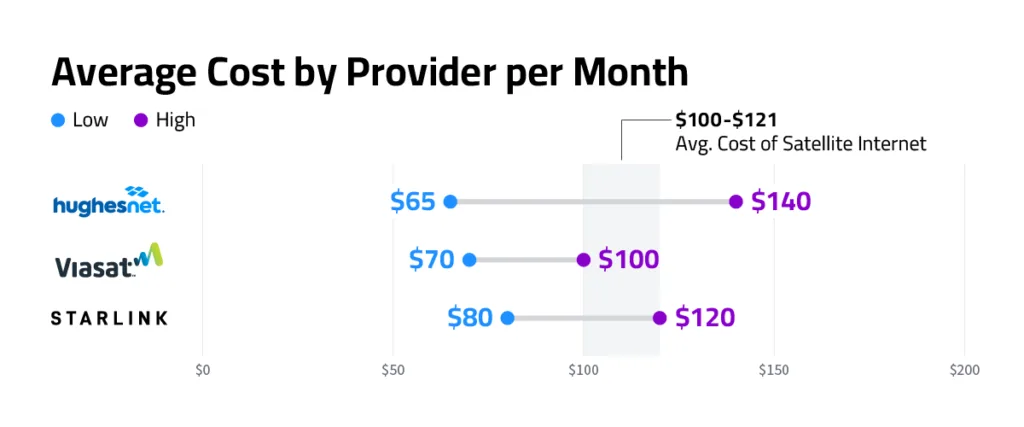
The average cost of satellite internet is roughly $100 per month. This makes satellite internet about 32% more expensive than the national average broadband cost of $76-$81 per month.

For rural Americans, who have a median household income of $49,895, paying for satellite internet can consume 2% to 3% of their annual gross income.

Provider Pricing at a Glance

Provider
Starting Price
Typical Monthly
Max Speed
Cost Per Mbps (Avg)
Starlink
$50/mo.$80–$120/mo.400 Mbps$0.04/Mbps
Viasat
$69.99/mo.$70–$100/mo.150 Mbps$0.57/Mbps
HughesNet
$39.99/mo.$65–$140/mo.100 Mbps$1.96/Mbps

Source: Provider websites, 2026 data. Pricing and speeds vary by region.

If you look at the starting price alone, Hughesnet appears to be the cheapest. However, because their speeds cap out at lower levels, they are actually the most expensive when calculated on a per-Mbps basis. Hughesnet averages nearly five times the cost per Mbps of Starlink.

When choosing a provider, you also have to factor in equipment. Starlink requires you to purchase the hardware upfront (ranging from the $199 Mini to the $349 Standard Kit), whereas Viasat and HughesNet primarily rely on monthly equipment leases.

Based on our editorial estimates for the first year of service (including typical plans, 12 months of service, and all equipment fees), a typical Starlink setup will cost around $1,789, Viasat Unleashed will cost between $1,076 and $1,376, and Hughesnet Elite will cost between $960 and $1,140.

Image by Kayla Fischer for SatelliteInternet.com

Performance & The Technology (LEO vs. GEO)

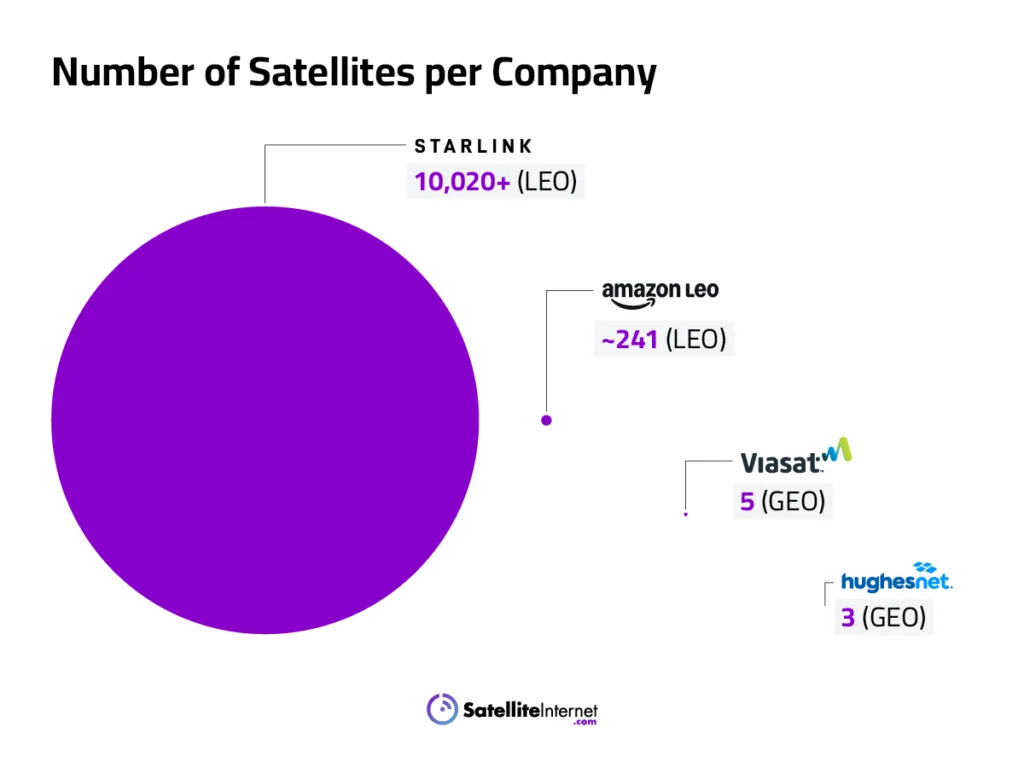
Why does Starlink perform so differently from Viasat and Hughesnet? It all comes down to the types of satellites they use. Viasat and Hughesnet operate with high-orbit geostationary (GEO) satellites, while Starlink and newcomers use low-Earth orbit (LEO) satellites.

Image by Kayla Fischer for SatelliteInternet.com

GEO satellites orbit roughly 22,000 miles away. Because of their incredible height, a company only needs a few satellites to cover the whole globe. However, the signal has to travel 44,000 miles round-trip, resulting in a latency (lag) of 600 to 700 milliseconds. This latency makes real-time applications like video calls and online gaming virtually impossible.

LEO satellites, on the other hand, orbit much closer to Earth—between 340 and 1,200 miles away. This cuts latency down to a cable-like 20 to 50 milliseconds, making LEO latency over five times faster than GEO. The tradeoff is that you need thousands of LEO satellites flying in a "constellation" to provide continuous coverage.

Real-World Speeds by Provider

Provider
Median Download
Median Upload
Median Latency
Orbit
Starlink
104.71 Mbps14.84 Mbps45 msLEO
Viasat
49.12 Mbps1.08 Mbps684 ms GEO
HughesNet
47.79 Mbps 4.44 Mbps 683 ms GEO

Source: FCC/Ookla Speed Data, 2026.

While satellite internet averages 65.2 Mbps across all providers, this is still about 70% slower than terrestrial cable or fiber options, which average around 242 Mbps nationally. Currently, Starlink is the only satellite provider that consistently meets the FCC's 100/20 Mbps broadband standard in real-world testing. Viasat's median upload speed of 1.08 Mbps essentially disqualifies it for heavy remote work or video streaming.

Competitors & The Future

The sky is getting crowded. Currently, Starlink constitutes roughly 65% of all active satellites in orbit, boasting an armada of over 10,020 LEO satellites. But competition is heating up fast.

Amazon Leo (formerly known as Project Kuiper) is heavily targeting the space layer. As of April 2026, Amazon has approximately 241 operational LEO satellites in orbit. They are targeting a full U.S. consumer launch by mid-2026 with advertised speeds up to 1 Gbps—roughly double Starlink's typical performance. Amazon plans to launch a total of 7,727 satellites eventually.

Meanwhile, ground-based alternatives are stretching further into rural territory. Fixed wireless connections, such as T-Mobile Home Internet, offer typical speeds of 134 to 415 Mbps for a flat $50 per month with no equipment fees, presenting Starlink's most direct pricing rival wherever 5G tower coverage exists.

Andreas Rivera
Written by
Andreas Rivera is a lifelong writer with a decade-spanning career in journalism and marketing. He comes to SatelliteInternet.com with several years of experience writing about business and technology. His passion for researching the latest advancements in tech, especially the now essential need for reliable internet access, fuels his goal of educating others about how these innovations affect and improve our everyday lives. When not researching and writing about SatelliteInternet.com, you’ll likely find him buried in a good book or enjoying the great outdoors with a fishing rod.