

Amazon Leo vs. Starlink

Amazon Leo
  • pro
    Slated for a 2026 launch
  • pro
    Promises competitive pricing
  • pro
    Projected 400Mbps download speed for residential, 1Gbps for enterprise
Starlink
Starlink
  • pro
    Available now
  • pro
    Residential plans start at $80/mo.
  • pro
    Up to 400Mbps download speed

Dave Schafer
Dec 05, 2025
Icon Time To Read4 min read

Starlink is definitely the highest-profile (and highest-performing) satellite internet provider currently available. There aren't many satellite providers to begin with, so competition is sparse. However, retail and tech giant Amazon will soon enter the market to take on Starlink directly.

Amazon Leo (formerly known as Project Kuiper) is the company's upcoming satellite internet service, which it plans to make available to customers sometime in 2026, with a model similar to Starlink.

We'll compare what we know about Amazon Leo with Starlink and see how the two might stack up. What's similar, what's different, and if you should get Starlink now or wait for Amazon Leo.

Since Amazon Leo is not widely available yet, we won't recommend a winner in each section—at least for now. Once the service rolls out and we can see real performance metrics, we'll be able to offer more concrete advice.

What makes Amazon Leo and Starlink similar?

Starlink is the first consumer satellite internet provider to use low-earth orbit (LEO) satellite technology. Competitors like Hughesnet and Viasat use geostationary orbit (GEO) satellites to connect users to the internet. GEO internet only requires a handful of satellites, but their performance is lagging. LEO, on the other hand, uses thousands of satellites in close proximity to Earth to deliver near-broadband speeds. Amazon Leo emulates this method with its own growing fleet of close-orbit satellites. 

Starlink uses personal terminals to connect customers to the web, ones that don't necessarily need to be attached to your roof or carefully oriented like traditional dishes. Amazon Leo seems to use the same model, where you can connect to the web via the terminal.

Amazon Leo vs. Starlink prices, plans, and speeds

Amazon Leo has yet to formally announce pricing or package structure. It has been stated that it will be priced competitively, likely meaning in line with Starlink's pricing. Hardware pricing is also unknown, and it's unclear whether Amazon plans to follow Starlink's model of selling customers the equipment or leasing it, as most ISPs do.

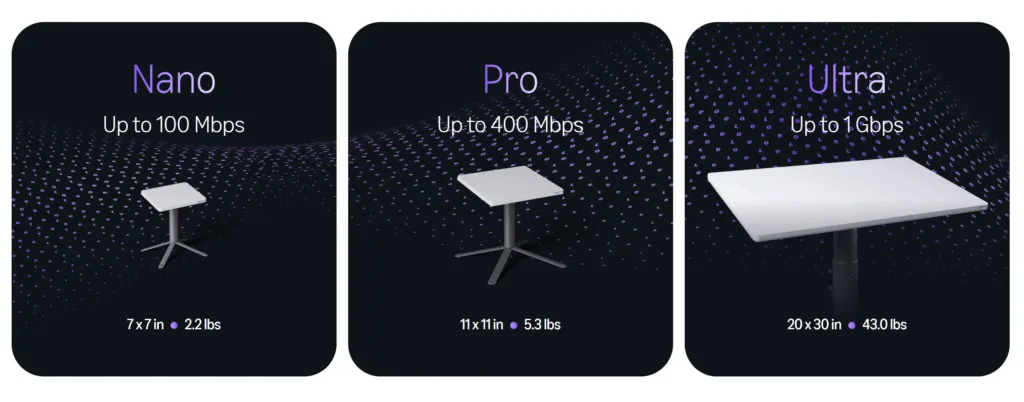
As far as performance, Amazon has revealed its three options for customer terminals and their expected download speeds. According to Amazon:

  • The Nano will deliver speeds up to 100Mbps
  • The Pro will deliver speeds up to 400Mbps
  • The Ultra will deliver speeds up to 1Gbps

The ability to deliver 1Gbps download speed surpasses anything Starlink currently offers, even with its enterprise service.

Starlink

Starlink plans and pricing

Plan
Price
Speed
Latency
Recommended Equipment fee
Starlink Residential$80.00—$120.00/mo.Up to 300Mbps30—40ms$349.00
Starlink Roam$50.00–$165.00/mo.Up to 260Mbps<99ms$299.00–$349.00
Starlink Local Priority$65.00–$540.00/mo.Up to 400Mbps30—40ms$349.00
Starlink Global Priority$250.00–$2,150.00/mo.Up to 400Mbps<99ms$1,999.00

Starlink’s Residential plans start at $80 per month, with an upfront cost of $349 for the Standard dish. However, Starlink has recently reduced the initial costs by offering $40-per-month plans and leasing dishes for $0, but only in select regions. Typical performance for Starlink's full Residential service ranges from 200 to 400Mbps.

In the meantime, the Starlink Roam plans have a data-capped 50GB plan for $50 per month and an Unlimited plan for $165 per month. Speeds for Roam are slightly reduced, but you can take advantage of being able to use it anywhere, and even while moving. The Starlink Mini is an even more portable version of the hardware, perfect for use with the plans.

While Amazon Leo claims its enterprise offering will reach up to 1Gbps download speeds, Starlink also claims it will also offer gigabit internet in the near future as it launches more satellites with improved technology. 

Amazon Leo vs. Starlink equipment

Both Amazon Leo and Starlink have three main dishes to offer customers, with Amazon's planned terminals pairing up against each of Starlink's. 

For home

Amazon Leo Pro dish

Starlink Standard dish

The Amazon Leo Pro is a square residential dish measuring 11 inches by 11 inches, according to Amazon. It’s comparable to Starlink’s Standard dish, which is 23 by 15 inches. The dishes are primarily designed for use in a fixed location for home internet, but the Starlink Standard can also be used with the portable Roam plan, allowing it to be used almost anywhere. It's unclear if that will be the case for the Leo Pro.

For travel

Amazon Leo Nano dish

Starlink Mini dish

Amazon will also offer a more portable version of the dish called the Leo Nano. It's only 7 inches by 7 inches, which is comparable to the Starlink Mini dish, which is about 11.5 inches by 10 inches.

For business

Amazon Leo Ultra dish

Starlink High-Performance dish

For business and power users, Amazon Leo Ultra is significantly larger, measuring 19 inches by 30 inches, compared to Starlink’s own High Performance dish, which is 15 inches by 24 inches. 

Installation

Starlink is a self-install internet provider. The company ships your equipment, and you set it up yourself using the Starlink mobile app. It’s straightforward, provided you don't need to mount the dish on your roof, which requires additional tools and equipment. Starlink contracts third-party installers, but only in select states. That said, some people would definitely prefer a more hands-off approach.

There's no insight into Amazon Leo's installation strategy, but it's safe to say it may follow a similar model.

Amazon Leo vs. Starlink availability

Amazon Leo availability

The project also seems to have a very global attitude, aiming to help bridge digital divides and bring services to underserved areas. Amazon Leo has expressly stated it intends to operate in “many countries around the globe." Indeed, many countries have already expressed interest in bringing Leo to their populations.

Amazon Leo has also announced it will offer portable options, akin to Starlink's Roam plans, allowing customers to bring it with them on the move.

Starlink availability

Starlink offers nationwide availability. Anyone in the U.S. can get their hands on a Starlink kit and get connected from 99.9 percent of the country. One caveat, though, is that Starlink's network bandwidth is not equal everywhere. Its speeds vary by region, and Starlink even imposes extra charges on customers in areas with sparse bandwidth, as a way to discourage new sign-ups.

Starlink also offers portable service through Starlink Roam service plans. Overall, we don't think coverage will be an issue for most Starlink customers.

Dave Schafer
Written by
Dave has written professionally for tech companies and consumer technology sites for nearly five years, with a special focus on TV and internet. He uses his industry expertise to help readers at HighSpeedInternet.com get the most out of their services. No matter the project, he prefers his coffee black (the stronger, the better).