Viasat Internet Review: Reliable Internet for Rural Situations

Viasat
Viasat
Viasat
3.7 out of 5 stars
3.7
  • pro
    Speed and latency – 3.0/5
  • pro
    Reliability – 2.7/5
  • pro
    Data – 4.8/5
  • pro
    Value – 4.4/5

Andreas Rivera
Oct 30, 2025
Icon Time To Read7 min read

Viasat Home Internet is the best choice for customers who need reliable satellite internet in rural America and don't need intensive bandwidth—all for a competitive price. I used Viasat for several months, and despite its reputation for subpar service, I was surprised by how viable it was for everyday internet usage. Still, I experienced mixed performance and gained a better understanding of the imperfections that come with satellite internet, which also came up as I interviewed many Viasat customers during my research for this review.

“Viasat speeds were good, but the latency was bad—800ms plus,” former Viasat customer Jason Astel told me in a recent interview. “It was not an ISP to stream anything.”

While many customers I interviewed expressed frustration with their service, I found Viasat sufficient for streaming, making video calls, and working from home.

Is Viasat a good enough solution to pick over competitors Hughesnet and Starlink? Hughesnet offers more affordable plans, with the performance expected to be similar to Viasat. However, unlike Viasat, Hughesnet is held back by a two-year mandatory contract and a hard data cap. Starlink, which I've also tested, is hands down the fastest satellite internet solution, but comes with expensive equipment and service plan costs. I found Viasat to be a great, middle-ground solution that makes sense for customers in rural locations and one I could see myself using full-time at my cabin.

Info

How I wrote this Viasat review

I'm a technology writer with a decade-long career reviewing products and services. I tested Viasat throughout 2024 and 2025 at my family cabin in rural Utah, in a mountainous, forested area. I also interviewed several current and former customers to learn how Viasat meets their needs.

How we rate and compare satellite internet providers

Using firsthand testing results and experience, I break down satellite internet providers' ratings into four categories.

Speed

Takes into account the provider’s download/upload speeds and average latency.
Purple and blue check mark icon

Reliability

Rates the consistency of service and access to customer support.

Data

Rates the allotment of high-speed data in a provider’s plans, taking into account priority data and options for purchasing more data.

Value

Rates the pricing (including fees, discounts and special offers) of services for what you’re getting and compared to competitors.

To keep a fair comparison, we rate satellite internet providers only against other satellite internet competitors.

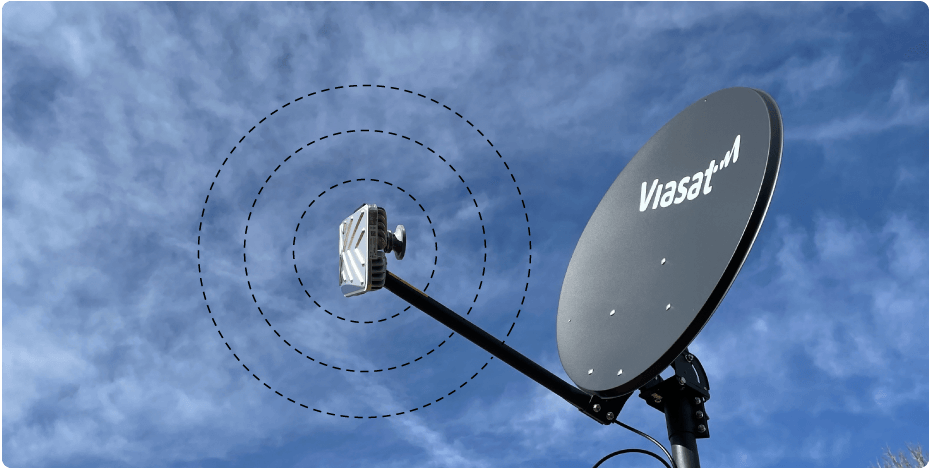
My first-hand experience with Viasat makes me recommend it as a good value, especially if you don't need heavy bandwidth. | Image by Kayla Fischer, SatelliteInternet.com

Our Viasat provider rating by category

Speed and latency

3.0 out of 5

While Viasat advertises download speeds up to 150Mbps, these are not guaranteed and depend on your location. Still, this should be enough for streaming, web surfing, email, and voice chat. I entered dozens of zip codes across the country into Viasat's site and found that 100Mbps was the most common top speed, with 150Mbps rarely available. My own purchase speed was reportedly up to 100Mbps, but my actual speed, according to multiple speed tests, ranged from 40Mbps to 50Mbps.

So, while download speed sometimes surpasses Hughesnet, it's middle-of-the-road in the best-case scenario, and it will rarely outmatch Starlink. Another critical metric to consider is average latency. Unfortunately, this is a common weakness among satellite providers. While download speeds are decent, your internet will still appear slow because the signal has traveled a long distance.

"Zoom works relatively well, although the resolution is not great and it sometimes has to buffer." — Viasat customer Sal Salamone, in rural upstate New York

Average latency from providers like Viasat has been measured in the hundreds of milliseconds. Customers I spoke with reported latency between 600 and 800 milliseconds (for comparison, the average cable latency is 15 to 35 milliseconds). They told me multitasking on the internet is challenging and incredibly frustrating when multiple people use it.

I got firsthand experience with Viasat's performance, and, contrary to other customers' frustrations, I was surprised by how decent my speeds were. I could stream live TV and movies, browse the web, and hold video calls with coworkers. However, high latency was noticeable, as it took a few more seconds than usual for a web page to load or for a Netflix movie to start. Unfortunately, signal interruptions are also common with satellite internet, so if my connection were suddenly interrupted, it would take several seconds for my movie to buffer and resume. These interruptions weren't that long, but they were more frequent and somewhat annoying during peak hours in the evening and when multiple devices were connected.

Light Bulb
Is Viasat good for gaming?

Because of its high latency, satellite internet shouldn't be your first choice for online gaming, particularly multiplayer or competitive gaming. Even Viasat doesn't recommend it for fast-paced, multiplayer gaming.

Purple and blue check mark icon

Reliability

2.7 out of 5

A dish technician installs the Viasat dish and modem. The installation took about 90 minutes to complete, and the technician was accommodating of how I wanted the equipment installed. | Photo by Andreas Rivera for SatelliteInternet.com

Customers I've spoken with say that while speed can be an issue, it's rare for it to stop working—although some told me their service can be spotty. The weather will significantly affect the speed of your Viasat service, as it does with any satellite provider. While using it, I never experienced a complete service outage. Even when it was overcast, I could still get a signal.

Customer support left a positive impression on me. Both my purchase, installation, and subsequent support calls were responsive and painless. Getting signed up was quick, and my installation took place just a few days later, at a time that was most convenient for me. My installer was knowledgeable, polite, and willing to answer all my questions. At a certain point, I decided to put my service in “hibernation mode,” which temporarily deactivates the service without canceling your account—useful for customers who only use it part-time of the year. This process was quick to initiate, and the customer rep I spoke with answered my questions.

"The install was simple. Customer service was always good and canceling was easy—they even credited me back some money." — Former Viasat customer Jason Astel, from rural Missouri

Data

4.8 out of 5

Viasat outshines its competitors in unlimited data. With its updated Unleashed plan, Viasat is the only satellite internet provider that offers its fastest speeds with unlimited high-speed data. While Viasat's Unleashed data plan is virtually limitless, it warns customers that if they exceed the monthly standard data usage limit — 850GB, according to Viasat — they will likely see slower speeds to conserve bandwidth.

Hughesnet manages its network's traffic with a 200GB cap on priority data, so your speeds will slow to around 1 to 3Mbps once you go over. Starlink's priority plans offer up to 220Mbps, depending on location, while the Standard Starlink plan offers unlimited data at around 150Mbps. Viasat will be better suited for heavy-data households, but it's tough to say how consistent the speeds will be, given that every customer will have free rein with unlimited high-speed data.

Viasat's Unleashed plan offers unlimited data, ideal for customers who stream a lot. Streaming can drain allotted high-speed data, but since Viasat virtually eliminated its cap, you shouldn't have to worry about running out even when you watch HD or 4K TV.

Value

4.4 out of 5

So, is Viasat worth it? It depends on what's available in your area and what you primarily use the internet for. Its main internet plan ranges from $99.99 to $129.99 per month, depending on your location. Also, be aware that you'll need to pay a monthly equipment lease of $15, and you may need to pay an installation fee of up to $300, pending a soft credit check, though my own installation was free.

If you use a lot of data (e.g., streaming daily, working from home through the web, frequently videoconferencing, and sharing large data files), the promise of unlimited high-speed data should appeal to you. This is especially true compared to Hughesnet, which caps customers at 200GB per month.

Viasat also joins Starlink in ditching a mandatory contract, letting you pay month-to-month and end service whenever you want. Hughesnet is the only primary satellite internet provider in the U.S. that requires a two-year commitment and will charge an early termination fee.


Viasat
Overall
3.7 out of 5 stars
3.7

Final Verdict

Viasat is a viable, middle-of-the-road option for people in rural homes, whether it's a primary residence or a second home. It's certainly not the fastest solution, but it features enough bandwidth for most online activities. It is not as fast as Starlink, but much more affordable. Hughesnet remains the lowest-cost provider, but Viasat's advantage lies in not requiring a two-year contract or priority data caps like Hughesnet does.

If you're in an area where you can only get the Viasat plans listed in the "very remote areas" table, we suggest looking at Hughesnet, Starlink, or a satellite internet alternative.

How do Viasat's ratings compare with those of satellite internet competitors?

Category
Viasat
Hughesnet
Starlink
Speed/Latency
3 out of 5 stars
3
3.4 out of 5 stars
3.4
4.9 out of 5 stars
4.9
Reliability
2.7 out of 5 stars
2.7
3 out of 5 stars
3
3 out of 5 stars
3
Data
4.8 out of 5 stars
4.8
2.6 out of 5 stars
2.6
4.5 out of 5 stars
4.5
Value
4.4 out of 5 stars
4.4
4 out of 5 stars
4
2.6 out of 5 stars
2.6

Viasat is in the middle of the pack price-wise. Its Unleashed plan is usually more affordable than Starlink’s standard plan but slightly more expensive than Hughesnet’s Elite plan ($89.99 per month plus a one-year discount of $25 per month). However, moving away from mandatory contracts and providing virtually unlimited data makes the higher cost worth it, as it allows you to be more flexible. Hughesnet users need to be ready to have the service for at least two years.

For a deeper dive into these internet services, check out our full Hughesnet vs. Viasat breakdown. Viasat Internet and Starlink Internet are on more even footing when it comes to pricing. Starlink wins out because its technology enables faster, lower-latency internet.

What Viasat customers told me about their experience

Customers I got in touch with often struggled to find anything overly optimistic to say about their Viasat service.

“Viasat speeds were good, but the latency was bad—800ms plus,” former Viasat customer Jason Astel told me in a recent interview. “It was not an ISP to stream anything.”

Astel, who lives in rural Missouri, originally got it for home entertainment and his children's school. Since streaming wasn't a viable option, he told me he had to supplement with a satellite TV plan, which increased his bill even more. Astel left Viasat for Starlink, which he says has been a much better experience.

“The actual service has been reliable enough not to have to contact customer service,” said Michael David, a network engineer who uses Viasat at work. In rural areas across the country, David's work uses Viasat as a backup in case its primary internet connection goes down.

“During typical times, it’s not so bad, but when there’s a lot of volume on the network, the congestion can cause packet loss and errors with multiple devices,” he said.

Not everyone had a consistent signal. The online discourse surrounding Viasat often includes comments about dropped service and slower-than-advertised speeds. One customer I interviewed said his service was constantly spotty, even on clear days.

“Zoom works relatively well, although the resolution is not great and it sometimes has to buffer,” said Viasat customer Sal Salamone, in rural upstate New York. “My work requires I use a VPN, and it’s impossible with Viasat. It slows it down too much.”

Salamone said that when he upgraded his plan a few years ago, the service improved nominally, but it was not worth the higher monthly payment.

“There’s just no comparison,” Salamone said when comparing Viasat to traditional broadband internet.

Andreas Rivera
Written by
Andreas Rivera is a lifelong writer with a decade-spanning career in journalism and marketing. He comes to SatelliteInternet.com with several years of experience writing about business and technology. His passion for researching the latest advancements in tech, especially the now essential need for reliable internet access, fuels his goal of educating others about how these innovations affect and improve our everyday lives. When not researching and writing about SatelliteInternet.com, you’ll likely find him buried in a good book or enjoying the great outdoors with a fishing rod.